
One Day in Kalkara
A glimpse inside a future production day, and what a soundstage could add to filmmaking in Malta
It is midnight in Kalkara. Outside the studio walls, September is still hanging on to summer. The air is warm, damp and sticky enough for a T-shirt to cling to your back. Crickets are working somewhere in the dark, a dog has decided the entire neighbourhood needs to know it is awake, and further down the road two petrolheads disappear into the night at a speed most people in Malta would recognise...
Then the line producer opens the stage door.
(I know, I know. But it is my story, so I am opening the door.)
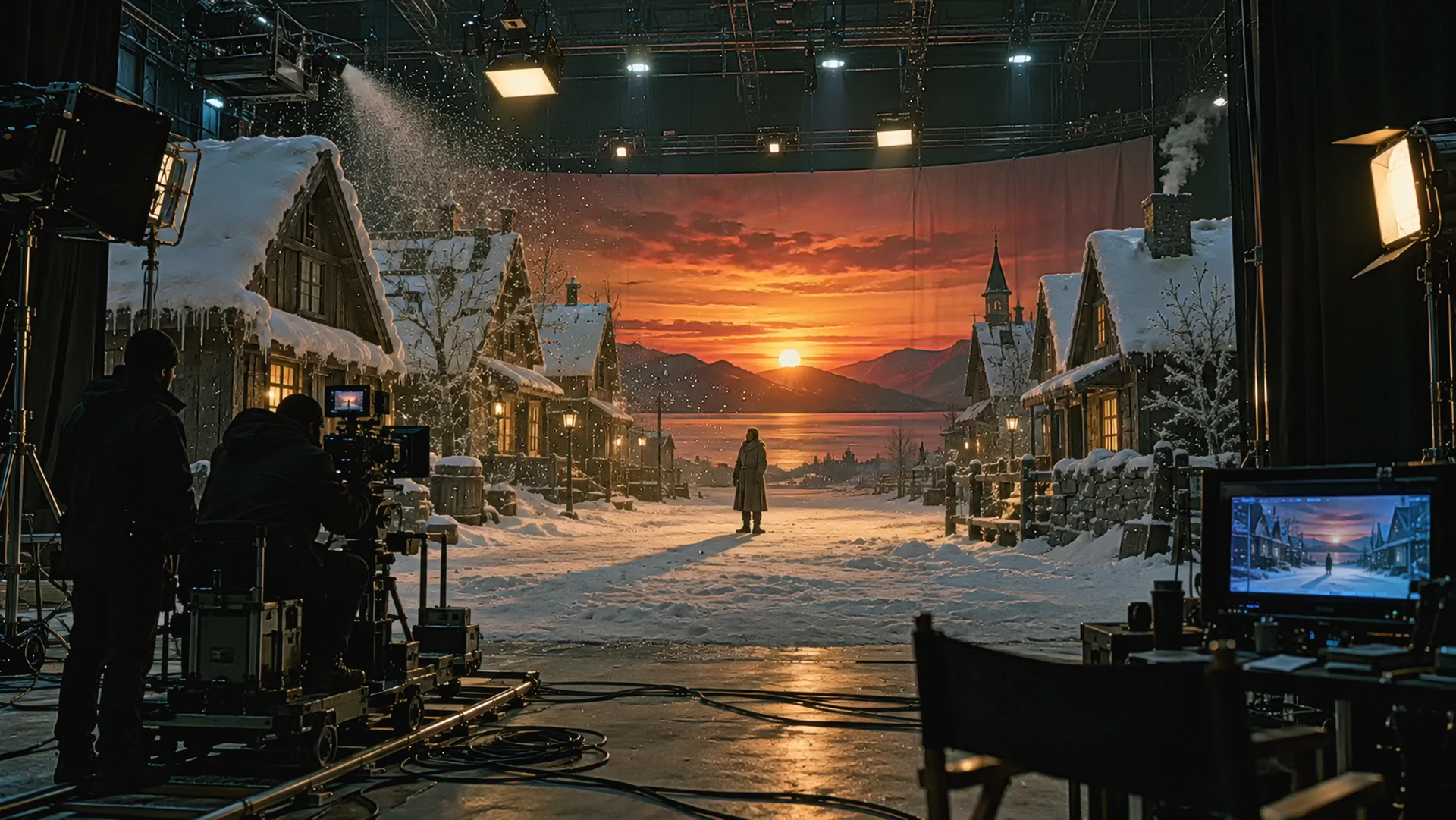
Inside, it is winter.
Snow is falling over a small village somewhere far to the north. Timber houses sit under white roofs, warm light glows behind frosted windows and smoke rises from a chimney into the cold air. At the far end of the street, the sun is setting.
It has been setting for three hours.
That soft, warm glow has not moved. The light still falls across the actor's face from exactly the same angle, the shadow still lands in the same place and the sky remains caught somewhere between gold and red. If production needs it, sunset can still be there tomorrow, and the day after that.
Outside, Malta is sweating through a September night. Inside, somewhere between Canada and Christmas, the snow keeps falling on cue.
Somebody calls cut. The snow stops.
I hope I am not spoiling the magic of cinema here. Quite the opposite, I hope. For me, seeing what goes on behind the screen has always made the magic a little more impressive.
So let's take a peek behind the silver screen. Or, these days, whatever LED, OLED or QLED version of it happens to be hanging on your wall.
None of what I have just described has happened in Kalkara.
Not yet.
But it is a useful way of understanding what a soundstage actually does.
In September, Malta announced plans for what it describes as the world's first land-sea super stage at the film studios in Kalkara. Roughly the size of a football pitch, with a filming pool beneath the floor, it would sit only a few steps from the deep water tank that has been there since 1979.
The announcement itself is not really the interesting part. What matters is what a building like that allows filmmakers to do.
The building that disappears
From the outside, there is very little magic about a soundstage. It is a big box: concrete, loading doors, trucks outside and cables everywhere. Then the door opens and suddenly you are in ancient Rome, Manhattan, the engine room of a submarine, or somebody's kitchen where one wall simply does not exist because the camera needs to stand where the wall should be.
If the stage is doing its job properly, the audience never thinks about the building. You think about Bond fighting through the belly of a supertanker in The Spy Who Loved Me. You wander through Willy Wonka's Chocolate Room. You arrive in the Greek village of Mamma Mia!. You watch a London Underground train tear through a tunnel in Skyfall.
Different films, different worlds, different decades. At one point, all of them lived inside the same enormous stage at Pinewood. The building simply changed clothes, and the audience never saw the room underneath.
Sets, though, are only half the story. The other half is control.
On location, sunset is beautiful partly because it does not last. For a few minutes the light softens, skin tones warm, shadows stretch and the whole world seems to glow. Then it is gone. If the camera was not ready, you wait for tomorrow.
Inside a soundstage, sunset can last three days.
The light does not move unless somebody moves it. The shadow remains where continuity needs it. Take forty can look like take one. The actor can leave for lunch, come back an hour later and still be standing in the same few minutes before dusk.
For a producer, that is where the romance becomes something very practical. That sunset can be put into a schedule, crewed and budgeted before anybody walks onto set.
A real location gives you the real thing, but it also gives you everything attached to reality: traffic, aircraft, neighbours, tides, closing times, weather, church bells, construction work and, occasionally, a dog that has decided it deserves a supporting role.
A stage makes a different bargain. Almost everything has to be created, but in return much more of the day agrees to behave. Uncertainty becomes timber, steel, paint, cable and labour. Those things cost money, but at least you know where to put them in the budget.
There is one thing filmmakers have never found quite so easy to persuade: the sea.
Try giving the sea a call sheet
The sea has never cared what time first shot is. If you need calm water, it moves. If you need rough water, it goes flat. If the wind changes, everything changes with it. Equipment gets wet, resets slow down and safety becomes part of almost every decision.
Water also has an annoying habit of giving away scale. You can build a miniature building and, with the right lens, fool the eye surprisingly well. Water is less forgiving. A small wave looks like a small wave. The audience may not know exactly what is wrong, but somehow the North Atlantic begins to feel suspiciously like somebody's swimming pool.
Visual effects have become extraordinarily good at creating water, but the eye remains sensitive to the way it behaves: its weight, reflection, spray and the way a body moves through it. Get enough of those things slightly wrong and something simply feels wrong.
So filmmakers found another solution: do not try to control the sea. Build a piece of sea you can control.
That is essentially what a filming tank does. The cleverest version is the horizon tank, where the controlled water ends at an edge with the real sea sitting beyond it. From the right camera position, the join disappears. An actor might be standing in warm water only a metre or two deep, while the camera sees an ocean.
In Malta, it sees the Mediterranean.
When the film leaves but the room stays
Some of the most useful pieces of film infrastructure exist because one production once asked for something ridiculous.
In 1976, The Spy Who Loved Me needed the inside of a supertanker large enough to swallow three nuclear submarines. There was nowhere in Europe big enough to build it, so Pinewood built somewhere.
The film finished. The stage did not.
It outlived the production, later survived a fire and a rebuild, and kept working. The submarines disappeared, Willy Wonka moved in, then Mamma Mia!, and eventually Bond came back. A room built to solve one film's impossible problem went on solving other films' impossible problems decades later.
Titanic did something similar with water. In 1996, Fox needed somewhere large enough to put the ship at sea and, eventually, sink it. The answer was an entire studio complex on the Mexican coast built around a 64-million-litre horizon tank facing the Pacific.
When Titanic finished, nobody filled it with concrete. Pearl Harbor used it. Master and Commander used it.
Malta already knew this story.
The shallow tank at Rinella was built in 1964 when The Bedford Incident needed controlled sea conditions. The deep tank followed in 1979 for Raise the Titanic. Malta built a tank for a Titanic film seventeen years before Hollywood built one for the other.
Both sit against the Mediterranean. The water closest to camera can be controlled, while beyond it the horizon is real. And the films kept coming. U-571 fought its war there. Troy sailed from there. Captain Phillips was hijacked on that water. Napoleon and both Gladiator films put fleets on it.
Salvatore Tirone looked back at Malta's century-long relationship with cinema in an earlier entry.
Then came The Last Voyage of the Demeter. A full-scale nineteenth-century ship, around sixty metres long and weighing more than a hundred tons, was built in Malta and floated in the tank.
Stand on the deck and face the horizon and the Demeter is alone at sea. Turn around and the magic changes shape. There are crew, safety teams, equipment, the edge of the tank and Malta sitting just beyond it.
Even emptiness needs producing.
A modern boat wandering across the wrong part of the horizon can suddenly put the twenty-first century into Dracula's voyage. The audience sees a ship isolated in open water. Behind the silver screen, that loneliness had to be organised.
There is something slightly odd about the history of all this. Film technology grows old very quickly. Good production infrastructure often does not.
A stage built because Bond needed somewhere to park three submarines is still useful almost fifty years later. A tank dug for one production in Malta in 1964 is still working. The films leave, but the infrastructure waits for the next one.
What Malta has historically lacked at that scale is the other half of the equation: a roof.
But surely we can just generate it now?
This is where the question becomes interesting in 2026.
Why build an enormous soundstage now?
We can replace skies, extend sets, build digital cities and create oceans. AI can produce images in seconds that would once have taken teams considerably longer. At first glance, a giant room full of timber, cables, lights and people can sound almost old-fashioned.
Yet the opposite has been happening. The technology moved inside.
When The Mandalorian went into production, more than half of its first season was filmed inside a huge curved wall of LED screens. The desert behind the actors was digital, but the light coming from it was not.
Put a digital sunset behind the Mandalorian and that sunset throws real light across his armour. Move the camera and the landscape changes perspective with it. The desert may never have existed, but its reflection did.
The industry calls that room a volume. Strip away the terminology and it is still a soundstage. The digital world did not replace the room. It moved in.
Water tells much the same story.
Avatar: The Way of Water is about as digital as modern filmmaking gets, yet James Cameron still built a physical indoor tank of roughly a million litres because the actors had to perform underwater. They swam, held their breath and displaced real water. Technology captured those performances and built another world around them.
Even at that level of filmmaking, some problems remain wonderfully ordinary. Thousands of white balls were floated across the surface of the tank because unwanted reflections were interfering with the performance-capture cameras.
One of the most technically sophisticated productions in cinema history still ended up with people standing beside a pool trying to stop light bouncing in the wrong direction.
That may be a better way of thinking about AI and soundstages. They are not necessarily opponents.
The digital side will keep getting better. Backgrounds will become quicker to create, sets will extend further, weather can change and first versions of things that once took days may appear in minutes.
I have already given my view on where AI may leave the people doing the work in a previous entry.
But actors still need somewhere to perform. Stunts need somewhere they can be repeated safely. Cameras still need controllable light. Costume, makeup, grips, lighting, props and special effects still need somewhere to work.
The tools change, but the need for somewhere controlled enough to bring all of them together does not necessarily disappear with them.
Back to that September night
So return to that imaginary midnight in Kalkara.
Outside, the crickets are still going. The dog probably is too. Somewhere down the road, our two petrolheads may have finally found a red light. The real Mediterranean is sitting just beyond the studio, doing whatever the Mediterranean feels like doing that night.
The tanks at Rinella are open to the sky, and that is precisely why they work so beautifully. They give you real Mediterranean light and real water disappearing towards a real horizon.
But the thing that makes them beautiful is also the thing nobody controls. The wind still gets a vote. So does winter. If you need sunset, the real sun eventually sets. If you need night, you wait for night. If the weather changes, the shooting day may change with it.
Now imagine some of that work under a roof.
Shoot the real coast in the morning and move inside later. Sunset can last three days. A storm can happen while there is not a cloud outside, or a real storm can hit Kalkara while filming continues a few metres away under exactly the same light as it had an hour earlier.
The water can stay warm for the child actor who needs another take. A stunt can look terrifying on camera while becoming wonderfully repetitive for the people whose job is to make sure nobody gets hurt. A ship's deck can remain standing rather than being rebuilt or moved. One unit can work outside on the real coast while another works under the roof.
That is where the idea of a land-sea stage becomes more interesting than the measurements on a plan.
Roughly 50 by 72 metres, fifteen metres of clear height and a pool beneath the floor. Those are numbers. What matters is what a production can do inside them: sea outside, sea indoors, side by side.
There is another part of this that matters particularly for Malta. For decades, productions have come here for the thing that needs to be real: the water, the stone, the forts, the Mediterranean light.
Then, quite often, another part of the film goes somewhere else. The exterior is Malta. The controlled work lives in a studio in another country.
The Last Voyage of the Demeter is a neat example. The ship floated on Maltese water, while its interiors were built on stages in Germany.
There is nothing unusual about that. International productions move wherever the work makes sense. A large soundstage does not mean those interiors suddenly stay in Malta, and nothing guarantees that they will.
But it changes the conversation. Malta no longer has to be thought of only as the place where you come for the exterior before moving elsewhere for the roof.
Perhaps that is the simplest answer to why a soundstage still matters.
It is not there to replace the real world. It is there for the days when the real world refuses to take direction.
Outside our imaginary stage, Malta is still warm and sticky. The crickets are still chirping, and the real sea outside Kalkara is doing exactly what it wants.
Inside, the snow starts falling again. Somebody calls action, and sunset continues for another three hours.
Line producer by craft. Photographer by instinct. adelferrito.com